


RFID Labels
A Leading RFID Label Manufacturer
With ISO 9001 certification and a global supply chain, Jungle Wolf serves over 50 countries, boasting an annual production capacity of over 1 billion labels, solidifying its role as a key player in the RFID industry.
Multi-Frequency & Protocol Compatibility
Supports 13.56MHz (HF) and 860-960MHz (UHF) bands, compliant with ISO 14443A/EPC Gen2 protocols, enabling long read ranges (up to 15 meters for UHF) and seamless integration with global reader systems.
Extreme Environment Performance
Features anti-metal tags with ceramic substrates and absorption technology, boosting read distances by 80% on metal surfaces; high-temperature resistant series (-60°C to 250°C) designed for harsh industrial settings like metal smelting or automotive manufacturing.
Miniaturization & High-Efficiency Scanning
Offers ultra-small tags (as small as 3mm×0.8mm) for jewelry inventory or embedded applications, supporting bulk reading (300 tags per second) to enhance warehouse efficiency by 20 times compared to traditional methods.
End-to-End Customization
Provides flexible encapsulation (wet/dry/injection molding) and material options (PET, PVC, paper), with functional upgrades like sensor integration (temperature/humidity monitoring) and AES-128 encryption for secure, dynamic data management.
Stringent Global Quality Control
Implements full-process testing, including salt spray tests, bend resistance tests (>100,000 cycles), and 121°C high-temperature sterilization verification, ensuring consistent performance in extreme conditions.
Rapid Delivery & Scalable Production
Equipped with automated high-speed encapsulation lines (e.g., German Nepa systems), supporting fast prototyping (3-7 days) with a minimum order quantity of 5,000 units, and maintaining a daily output of over 500,000 labels to meet large-scale demands.


RFID Labels Definition
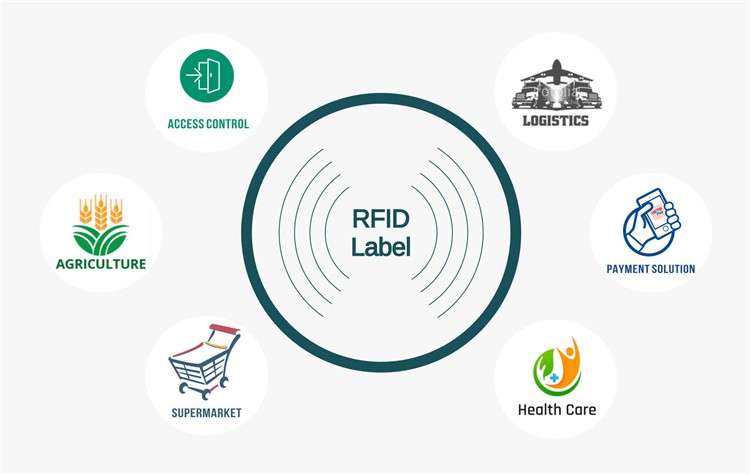
RFID Labels (Radio Frequency Identification Labels) are wireless communication devices based on radio frequency identification technology. They utilize chips and antennas to receive/send RF signals, enabling contactless data transmission and identification. Their core functions include storing unique identifiers (e.g., IDs, product information) or dynamic data (e.g., inventory status), widely applied in logistics tracking, retail management, access control, and security.
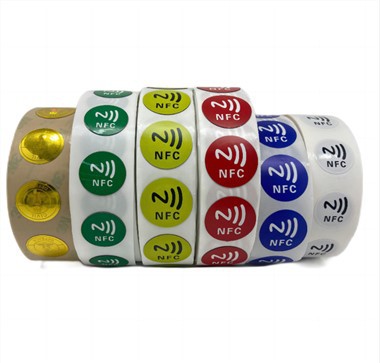
types of RFID Labels
Based on structural design, manufacturing processes, and application scenarios, RFID labels are categorized into three types: RFID Stickers, Dry Inlays, and Wet Inlays.

RFID Stickers
RFID Stickers are lightweight, flexible, and ready-to-use labels with integrated chips and antennas, typically based on paper, PVC, or PET substrates.
Core Features:
Structure: Substrate (paper/PVC/PET) + Chip + Antenna (printed or etched), with surface printing options for logos or text.
Process: Die-cutting, lamination, or UV coating to ensure thinness (0.1–0.3 mm) and flexibility.
Applications:
Retail: Price tags, promotional labels (bulk scanning).
Logistics: Shipping labels, pallet tracking (replacing barcodes).
Events: Temporary event passes, membership cards.
Advantages: Low cost (¥0.1–0.5/unit), easy application (no specialized tools), high compatibility (supports diverse substrates).
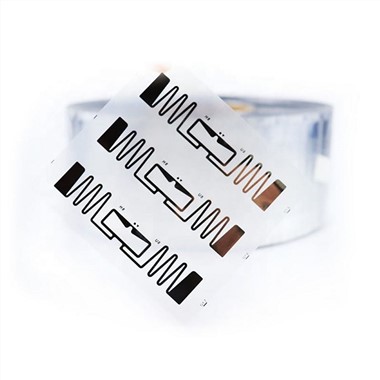
Dry Inlays
Dry Inlays are modular RFID tags pre-assembled with chips and antennas on a substrate, requiring embedding into carriers (e.g., cards, labels).
Core Features:
Structure: Chip + Antenna (copper/aluminum etching) + Substrate (PVC/ABS/paper), often with adhesive backing.
Process: Surface-mount technology (SMT) to weld chips to antennas, encapsulated in substrates for a unified module.
Applications:
Smart cards: Access cards, campus IDs (embedded in PVC cards).
Product packaging: Anti-counterfeit labels for luxury goods (embedded in boxes).
Industrial marking: Equipment tags (metal or high-temperature materials).
Advantages: High stability (firm chip-antenna integration), customizable (various sizes/chip types), broad compatibility (adapts to most readers).

Wet Inlays
Wet Inlays are RFID labels requiring wet-processing (e.g., glue application, curing) for adhesion, often pre-coated with adhesive.
Core Features:
Structure: Chip + Antenna + Substrate (PET/PVC), with pre-applied adhesive (e.g., acrylic).
Process: Substrate back-coated with glue during manufacturing; curing via pressure or heat for bonding to carriers (e.g., glass, metal).
Applications:
Logistics: Pallet/shelf labels (secure adhesion to metal/moist environments).
Industrial: Pipeline markers, machinery labels (heat/water resistance).
Outdoor: Traffic signs, public facility tags (UV/waterproof).
Advantages: Strong adhesion (cured glue resists peeling), durable (withstands extreme temperatures), suitable for mass production.

Structure of the RFID Label
The label, as the final product, consists of multiple layers of materials stacked as follows from top to bottom:
Printed Layer (Paper with Printing)
Material: Paper-based substrate (e.g., coated paper, synthetic paper) supporting printable content.
Function: Carries visual information (e.g., barcodes, text, graphics) for manual identification and display, while providing physical support for upper layers.
Antenna + Chip Layer (Antenna + Chip)
Core Components:
Antenna: A metallic (e.g., aluminum, copper) or conductive ink circuit pattern that receives/transmits RFID signals.
Chip: An integrated circuit (IC) storing data and communicating with readers via the antenna (supports HF, UHF, etc.).
Connection Method: The chip is fixed to the antenna via wire bonding or flip-chip technology to form the RFID functional unit.
Adhesive Layer (Adhesive)
Material: Pressure-sensitive adhesive (PSA) such as acrylic or epoxy resin, available in pre-adhesive (wet) or non-adhesive (dry, requiring later compounding) forms.
Function: Bonds the RFID functional layer to the printed layer and release paper, ensuring structural stability.
Release Paper (Release Paper)
Material: Silicone-coated paper or PE film with a non-stick surface.
Function: Protects the adhesive layer before use; the smooth surface allows easy peeling to expose the adhesive for attaching to objects.

Application of RFID Tags
Access Control and Security Management
Access Control Systems: Deployed in enterprises, office buildings, and residential communities, RFID access cards/wristbands verify identities and record entry/exit times to manage permissions.
Parking Management: Vehicles with RFID tags trigger automatic barrier lifting, enabling payment-free passage and improving traffic flow.
Controlled Area Access: Installed in labs, archives, or sensitive zones, RFID readers restrict unauthorized entry.
Logistics and Supply Chain Management
Warehouse Inventory Management: Tags on shelves and goods allow bulk scanning by readers to update inventories in real time, reducing manual counting errors (error rates drop from 1%-3% with barcodes to <0.1%).
Transport Tracking: Embedded in containers or pallets, RFID tags monitor cargo location, temperature (via sensors), and handling status, optimizing routes and minimizing loss risks.
Parcel Sorting: Distribution centers use RFID for rapid package identification, accelerating automated sorting by 30%+ compared to manual methods.
Agriculture and Livestock Farming
Livestock Management: Ear tags on cattle/sheep record breeding cycles, vaccination history, and health data, aiding disease control and traceability.
Smart Agriculture: Tags on farmland sensors monitor soil moisture/fertility; on greenhouse crops, they track growth data to automate irrigation/fertilization systems.
Food Traceability: Produce labeled with RFID allows consumers to scan for details on farms, processing, and quality checks, ensuring food safety.
Key Advantages of RFID Technology
RFID (Radio-Frequency Identification) technology delivers transformative benefits across industries through its unique capabilities:
Contactless Identification & Efficiency
Operates without physical contact, enabling automatic identification of multiple items within centimeters to meters (depending on frequency). Ideal for high-speed workflows (e.g., logistics, manufacturing).
Bulk Reading & Speed
Simultaneously reads hundreds of tags per second, outperforming barcodes for inventory scans, asset tracking, and real-time updates.
Enhanced Data Capacity
Stores up to 10KB of data (e.g., product IDs, batch numbers, location history), far exceeding barcode limitations.
Durability & Environmental Adaptability
Resists dust, moisture, and extreme temperatures. Suitable for harsh environments like warehouses, factories, or outdoor logistics.
Real-Time Tracking & Visibility
Continuously monitors asset location and status (e.g., cold-chain temperatures, machinery health), enabling proactive decision-making.

FAQ: Leading RFID Label Manufacturer
Why Choose Us?
We specialize in advanced R&D (laser-cut antennas, durable encapsulation), strict quality control (100% performance testing), scalable urgent orders, and hold ISO 9001/CE/RoHS certifications.
Quality Assurance: 100% performance testing ensures sensitivity consistency (±0.5 dBm).
Scalability: Flexible urgent orders with high-capacity production.
Certifications: ISO 9001, CE, and RoHS compliant.
Quality Assurance: 100% performance testing ensures sensitivity consistency (±0.5 dBm).
Scalability: Flexible urgent orders with high-capacity production.
Certifications: ISO 9001, CE, and RoHS compliant.
Do You Offer Free Samples?
Yes—standard samples are free; customized samples (logos/sizes) may incur fees, with 3–5 business day lead time.
Which Industries Do You Serve?
Retail (inventory/anti-counterfeiting), logistics (asset/cold-chain tracking), healthcare (patient IDs/medical equipment), apparel/jewelry (wash-resistant/high-security tags).
Can You Customize RFID Labels?
Yes—OEM/ODM for size, antenna design, materials (PET/ABS/epoxy), and functions (encryption/IoT integration).